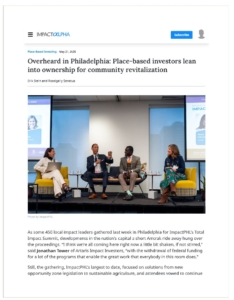
TIS25 featured a number of speakers – Andrew Siwo (Director of Sustainable Investments and Climate Solutions, New York State Common Retirement Fund), Melanie Schnoll Begun (Managing Director, Morgan Stanley), Erika Seth Davies (CEO, Rhia Venture), and many more – who highlighted the roles impact-first or impact-minded investors. Many impact investing organizations, from banks to investment funds to advisors and consultants, are waiting (or working to accelerate) for more foundations, family offices, and HNWI to embrace impact investing. Attendees learned that the Fed has a dedicated team focused on impact investing, led by Otto Kerr. His team’s work, including resources like “The Making Missing Markets Initiative” and “What’s Possible: Investing Now for Prosperous, Sustainable Neighborhoods,” underscores the growing recognition—at even the highest levels of finance—that inclusive economic prosperity requires targeted, mission-aligned investment strategies.
As federal dollars continue to shrink, the role of individual capital becomes even more critical. Through private investments, everyday investors can help bring essential community projects to life and see the tangible outcomes in their own backyards. Being at TIS25 led us to reflect on and ideate around the compounding impact of middle-class capital participating in private projects, as a well-thought-out part of their diversified strategy. Could this be a helpful diversifier on a development’s capital stack, along with institutions and family offices?
Here’s a tangible yet theoretical example here in Atlanta: What if a group of 100 upper-middle-class retail investors allocated, say, 5% of their portfolio to private investments? That capital could be pooled and invested in a fund like New Majority Capital (NMC), which is focused on minority access to entrepreneurship through acquisition. NMC could then partner with a local development project like South Downtown to bring a proven tenant with a history of business revenue, thereby giving that business an opportunity in a new, growing market and geography. Now imagine the compounded capital this could unlock for innovative, impact-driven development here locally if 10,000 retail investors allocated a portion of their portfolios to that purpose and execution.
Though this isn’t an easy challenge to tackle (especially as we acknowledge the risk in private market investments), we believe there is a significant win-win opportunity here–democratized access to this asset class for a broader socio-economic stratum of investors, and more capital unlocked for community-impact investments like affordable housing. As COO at Brighter Investing (an Atlanta-based RIA specializing in values-aligned investment strategies for anyone from middle-class investors to institutions and foundations), Kelsey has been building a strategy to create these retail-accessible capital deployment pathways, with a particular impact thesis around social justice here locally in Georgia. If you’d like to learn more, collaborate, or have individuals in your network interested in activating their capital in this way, please reach out!