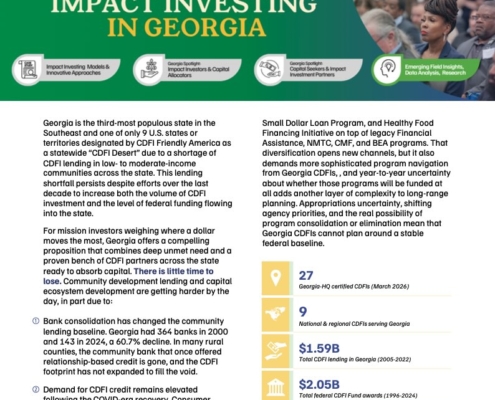
The “big field” of impact investing came to Atlanta. No, not in 2020, as Mission Investors Exchange (MIE) originally planned, but in April 2026, with a different set of national and global uncertainties in the room. The years between the COVID-delayed and the largest-ever MIE conference gave Georgia’s ecosystem time to evolve and grow. More foundations are practicing impact investing. The state has more CDFIs, more local investor circles, and more community and employee-owned businesses and trusts. Federal investment dollars and national sources of private capital reach Georgia in greater volume and with more regularity than before. Our ecosystem evolved on many fronts. The national conversation has changed, too. What impact investing is for, what it should change, and what greater systemic impact actually requires of capital…
Tag Archive for: CDFIs
Update: A federal judge has temporarily blocked the Trump administration from firing thousands of federal workers during the shutdown, including the CDFI Fund staff. This gives us breathing room, but the fight isn’t over. The lawsuits by federal workers’ unions and pushback from Republicans in Congress offer hope, but we can’t rely on courts alone If December 13 arrives without intervention, the immediate impact will be operational chaos. Pending applications will stall. Compliance questions will go unanswered. The FY 2025 funding round, with its innovative $100 million housing production initiative, will…
The question isn’t whether investing in Community Development Financial Institutions (CDFIs) carries risk. It’s whether we can afford the risk of letting them fail.
As foundations and asset allocators navigate an increasingly volatile economic landscape, I find myself fielding the same question repeatedly: “Should we double down on CDFIs right now, or is this the moment to pull back and protect our…