
Staring the Impact Investing Question Head-On:
Sydney England | March 9, 2026
Donor-Advised Funds (DAFs) hold $326 Billion, almost none of which is invested for impact. More than $326 billion sits in donor-advised fund accounts across the United States, yet only a sliver of that capital, roughly $3 to $4 billion, is invested in strategies designed to generate social or environmental impact alongside financial returns.[1] This is not a rounding error. It is one of the largest untapped opportunities in philanthropic finance: a quarter-trillion-dollar pool of irrevocably charitable assets, growing at 14% annually, parked overwhelmingly in conventional equity and bond portfolios while waiting to be granted.[2]
The constraint is not demand. A 2019 Social Finance/Rockefeller Foundation survey found that 72% of DAF donors expressed interest in impact-first investments.[3] The constraint is infrastructure, incentives, and a private wealth management system that has been engineered, over decades, to preserve and grow wealth rather than deploy it for purpose. With the global impact investing market now at $1.571 trillion and a $124 trillion intergenerational wealth transfer underway, the convergence of DAFs and impact investing could redirect tens of billions toward mission-aligned capital deployment.[4] But only if the gatekeepers, the DAF sponsors, financial advisors, and wealth managers who control the plumbing, decide to act. And increasingly, the donors they serve are giving them less room to stand still.
Donor-advised funds have become the fastest-growing charitable giving vehicle in the United States. Assets have nearly doubled from approximately $152 billion in 2020 to $326.45 billion in fiscal year 2024, according to the DAF Research Collaborative’s Annual DAF Report 2025.[5] The compound annual growth rate for charitable assets from 2019 through 2023 was 14.0%.[6] In FY 2024 alone, contributions surged 37.3% to $89.64 billion, while grants reached $64.89 billion, a 19% increase over the prior year. The number of DAF accounts hit 3.56 million, though this figure includes high-volume donation processor accounts. Excluding those, roughly 1.78 million traditional DAF accounts existed as of FY 2023.[7]
The landscape is dominated by a handful of national sponsors. Fidelity Charitable, the nation’s largest grantmaker, held approximately $48.3 billion in assets and distributed $14.9 billion in grants in 2024 and $18.3 billion in 2025.[8][9] Schwab Charitable (now DAFgiving360) held approximately $26.4 billion in assets, while National Philanthropic Trust granted $6.61 billion in FY 2025 alone. According to the Institute for Policy Studies’ Independent Report on DAFs, national sponsors represent only 3% of DAF sponsors but hold 70% of all DAF assets, take in 73% of contributions, and distribute 61% of grants.[10]
The Payout Debate Matters & Impact Investing Reframes It
The critical figure for impact investing advocates is the investable pool. With $326.45 billion in total assets and $64.89 billion granted in FY 2024, roughly $261 billion remains invested at any given time. Fidelity Charitable reports that three-quarters of contributed dollars are distributed within five years, but at any moment, the vast majority of DAF capital is invested in standard asset-allocation pools: diversified equity/bond portfolios ranging from conservative to aggressive, plus money market funds. These pools mirror conventional retirement account options, not philanthropic mission. Almost none of this capital is deliberately deployed for social or environmental outcomes.
The most concrete measure of current impact allocation comes from the dedicated impact platforms. ImpactAssets manages approximately $3 billion in entirely impact-oriented DAF assets across roughly 1,500 accounts.[11] CapShift, the leading impact investing intermediary for DAFs, announced it had mobilized $1 billion to date in impact investments through its platform as of 2024, doubling in a single year.[12] Even generously, this puts total impact-invested DAF capital at roughly $3 to $4 billion, barely 1% of the $326 billion total.
The most politically charged critique of DAFs is the “warehousing” problem: donors receive an immediate, full tax deduction upon contribution, but no legal requirement exists to distribute funds to operating charities on any timeline. Private foundations must pay out at least 5% of assets annually. DAFs face no such mandate. This structural gap has drawn sustained criticism from scholars, policymakers, and advocacy organizations. The aggregate payout rate reported by the industry, 25.3% in FY 2024 and consistently above 20% since tracking began, appears robust. But this figure is contested. The Institute for Policy Studies found the median payout rate across all sponsors was just 9.7% in 2023, and it has hovered around 9 to 10% for four consecutive years.[13] The discrepancy arises from methodology: aggregate rates are inflated by high-turnover donation processor accounts and large accounts that distribute quickly, while the median more accurately reflects typical sponsor behavior. Further complicating the picture, DAF-to-DAF transfers totaled an estimated $4.4 billion in 2023, money cycling between charitable intermediaries without reaching operating nonprofits, yet counted as both grants and contributions.
Key voices in the reform camp include Ray Madoff, professor at Boston College Law School and co-founder of the Initiative to Accelerate Charitable Giving; John Arnold, the billionaire philanthropist who co-launched that initiative in December 2020; and Chuck Collins, director of the Program on Inequality and the Common Good at the Institute for Policy Studies. David and Jennifer Risher founded the #HalfMyDAF movement, urging donors to distribute at least half their DAF assets annually. On the other side, the Philanthropy Roundtable has argued that mandating higher payouts would chill charitable giving, while the Council on Foundations and Fidelity Charitable have opposed legislative reform efforts.
Impact investing directly addresses the warehousing critique by transforming idle charitable assets from a political liability into a social asset. As Social Finance articulated in an analysis for Mission Investors Exchange, impact investments give DAF sponsors a way to demonstrate that value creation is not confined to grant payouts.[14] If hundreds of billions of dollars are going to sit in DAF accounts, and structurally, a large pool always will, those assets could generate social and environmental returns while awaiting distribution. NPT UK has framed the logic simply: because DAF assets have already been gifted, donors can afford to be more catalytic and risk-tolerant in pursuit of impact.[15]
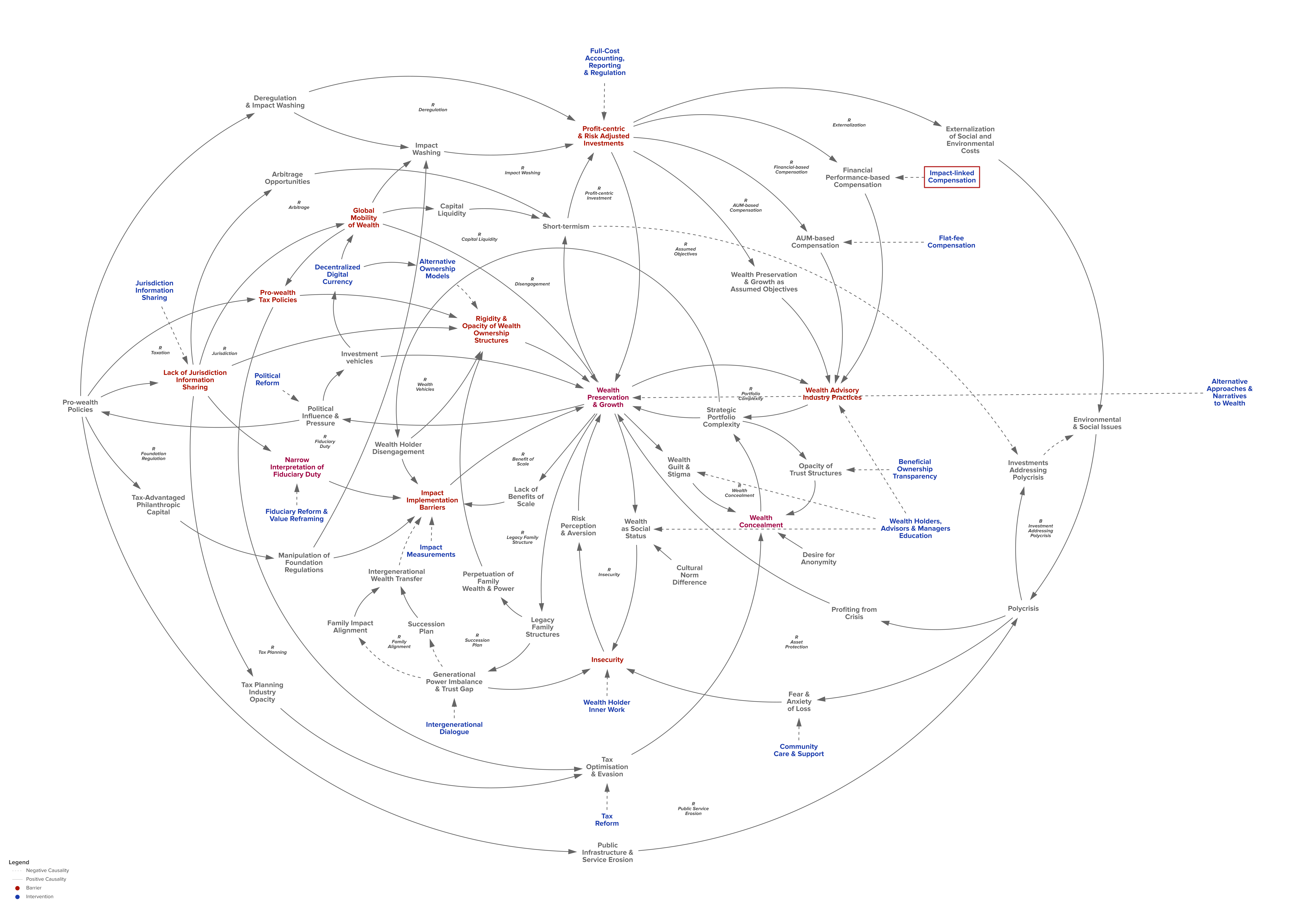
Breaking Barriers, Unlocking Capital
The Coalition for Impact (C4i), a global network of networks working to transform the private wealth system, partnered with Omplexity to produce a participatory systems map of how private capital flows, and why it flows where it does. The resulting Current Private Wealth System Map, published in their September 2025 report “Mapping the Private Wealth System,” identifies ten interconnected themes that shape how wealth is managed, invested, and deployed in developed economies.[16] Several of these themes speak directly to the inertia surrounding DAFs and impact investing. Zoom in on the image above to explore the Map and check out our more detailed blog article for more information. C4i partners identified three principal categories of obstacles that constrain impact investing in DAFs: fiduciary concerns, liquidity requirements, and regulatory uncertainty. Each is real but frequently overstated.
Fiduciary Concerns
Fiduciary duty does not require return maximization. DAF sponsors, as 501(c)(3) public charities, are governed by the Uniform Prudent Management of Institutional Funds Act (UPMIFA), adopted in 49 states. UPMIFA imposes duties of care, loyalty, and obedience, but critically, its eighth enumerated factor requires fiduciaries to consider an asset’s special relationship or special value to the charitable purposes of the institution.[17] The drafting notes explicitly state that charities must use an investment strategy that reflects the financial needs, charitable mission, and public benefit purposes of the entity, not maximize current returns.[18] Joshua Mintz, former General Counsel of the MacArthur Foundation, concluded in an influential 2021 analysis (updated January 2023) that boards may adopt ESG and impact investment approaches consistent with fiduciary duties, provided they carefully consider the implications, document the rationale, and monitor performance.[19] Moreover, 79% of impact investors target market-rate returns, and Bloomberg data shows the MSCI World Selection Index (ESG) returned 22.54% annualized over three years versus 22.27% for the conventional MSCI World Index.[20]
Liquidity Constraints
Liquidity constraints are real but manageable. DAF sponsors must maintain sufficient liquidity to honor grant recommendations at any time, which structurally limits allocations to illiquid investments such as private equity or private credit.[21] However, this is a portfolio-level constraint, not an all-or-nothing barrier. With 75% of DAF assets remaining invested year-over-year, sponsors can allocate a meaningful fraction, 10 to 20%, to less liquid impact strategies while maintaining ample liquidity for grantmaking. Social Finance’s donor survey found that interested donors were comfortable with concessionary returns and less liquid investments and willing to allocate approximately 26% of DAF assets to impact-first strategies.[22]
Regulatory Question Marks
The regulatory environment remains unsettled. The Treasury and IRS released their first proposed regulations under IRC Section 4966 in November 2023, the first major regulatory action since the Pension Protection Act of 2006 codified DAFs. Key provisions relevant to impact investing include treating zero-interest loans as distributions rather than investments, leaving program-related investments in a legal gray area for DAFs, and broadly defining “donor-advisor” to include personal investment advisors managing both DAF and personal assets, which could trigger excess benefit transaction penalties. Crucially, the proposed regulations state that investments generally are not distributions because they typically merely reflect a change from one form of property to another, which includes mission-related investments.[23] Nearly 200 comments were received and public hearings were held in May 2024. The regulations have not been finalized as of March 2026. The ACE Act (Accelerating Charitable Efforts Act), originally introduced in June 2021 by Senators Angus King and Chuck Grassley and reintroduced in the 119th Congress as H.R. 750, would create 15-year and 50-year DAF categories with distribution requirements, but has garnered minimal legislative momentum.[24]
The Social Finance/Rockefeller Foundation survey of 270 DAF donors found that interested donors would allocate approximately 26% of total DAF assets to impact-first investments. Applied to the current asset base, with 72% of donors interested, this implies a theoretical pool of roughly $61 billion in potential impact capital from DAFs alone. Even a conservative assumption, shifting just 10% of total DAF assets, would represent approximately $33 billion, a transformative injection into the $1.571 trillion global impact investing market.[43] For context, 94% of impact investors surveyed by GIIN reported that both their financial and impact performance met or exceeded expectations.[44]
Unlocking this capital requires action on several fronts. DAF sponsors need to expand impact investment menus beyond token ESG index funds. The major national sponsors currently restrict true impact investments, including recoverable grants, private credit, and PRIs, to their largest accounts, making these tools inaccessible to the majority of DAF holders. The IRS must finalize its proposed regulations with clarity on how program-related investments function within DAFs, because the current legal gray area chills innovation, and financial advisors need to be educated and incentivized to bring impact options to their DAF clients, rather than defaulting to conventional allocation models.
The broader market’s trajectory is clear. According to the Chronicle of Philanthropy, the combined assets in DAFs and foundations are projected to reach $2 trillion by 2026 and could account for half of all individual charitable donations by 2028. The 2025 “One Big Beautiful Bill Act” introduces a new charitable deduction floor of 0.5% of AGI starting in 2026, which may reduce marginal incentives for some donors but will not reverse the structural growth of DAFs. Meanwhile, the US SIF Foundation’s 2025 Trends Report found that $6.6 trillion in the US market is now invested in sustainable strategies, and 62% of respondents said the anti-ESG political environment had no effect on their decision-making.[45]
For DAF Sponsors:
Start with Who You Are, Not Who You’re Chasing
The temptation for any DAF sponsor watching this market evolve is to build an impact investing program designed to attract new donors. That impulse is understandable, and there is a genuine business opportunity here. Impact investing can draw in investment assets that were previously managed separately, and it can capture new pools of capital where foundation leaders, rather than financial advisors, have greater discretion over deployment. Those are real advantages worth pursuing, but the institutions most likely to succeed in this space will be the ones that resist the urge to chase a faceless DAF.
Community foundations, faith-affiliated sponsors, and mission-driven DAF providers have spent decades building something that national sponsors, for all their scale and fee advantages, cannot easily replicate: a relationship with a specific community of donors who chose them for reasons that go beyond price. Before building an impact investing mechanism, the most important strategic question is not “what products should we offer?” It is “why do donors come to us already, and why do they stay in this crowded landscape?”
That question matters because impact investing, done well, is an extension of institutional identity, not a bolt-on feature. A Jewish community foundation that launches an impact loan fund for affordable housing in its metropolitan area is doing something fundamentally different from a national sponsor adding an ESG index option to its investment menu. The community foundation is expressing its mission through its balance sheet. The national sponsor is checking a box. Donors can tell the difference, and increasingly they are shopping accordingly. Organizations like CapShift now publish guides that coach donors on how to evaluate a DAF sponsor’s impact investing capabilities before opening an account, walking them through specific questions about available options, recoverable grants, fee transparency, and due diligence partnerships.[42] This is a consumer empowerment movement. Donors with philanthropic ambitions are learning to evaluate providers with the same rigor they apply to any other financial product.
The institutions that have historically struggled most with DAF programs are the ones that tried to be everything to everyone, accommodating every donor’s bespoke preference at the expense of operational efficiency and institutional strategy. Impact investing can easily become the next version of that problem if it is approached reactively, as a response to whatever individual donors happen to request. The sponsors getting it right are the ones building from their institutional center outward. The Boston Foundation’s mission-first portfolios are rooted in Greater Boston’s specific housing, climate, and racial equity needs.[29] The Seattle Foundation’s Evergreen Impact Housing Fund is underwriting apartments in its own region.[30] The Jewish Community Federation’s impact loan program serves nonprofits and CDFIs within its own ecosystem. These are not generic impact products. They are expressions of place, constituency, and purpose.
The business case supports this approach. At a blended administrative fee of approximately 0.60%, the current $326.45 billion in DAF assets generates roughly $1.96 billion in annual administrative fees industry-wide, before investment management fees. Impact investing options can encourage longer holding periods and attract new account holders, growing both AUM and fee revenue. The success of ImpactAssets, which grew from $474 million to $3 billion in six years, and CapShift’s rapid expansion demonstrate market demand. But the community foundations and mission-driven sponsors that will capture the most meaningful share of that demand will be the ones whose impact offerings feel like a natural outgrowth of what they already stand for, not a defensive response to competitive pressure.
There is a demographic tailwind here that cannot be ignored. Cerulli Associates projects that $124 trillion in assets will change hands through 2048, with approximately $18 trillion flowing to charity.[34] Morgan Stanley’s 2025 Sustainable Signals survey found 88% of individual investors are interested in sustainable investing, including 99% of Gen Z and 97% of millennials.[35] Bank of America found that 73% of millennial wealthy individuals already use sustainable investments versus just 21% of older respondents.[36] And 74% of millennials identify as philanthropists, compared to 35% of baby boomers.[37] These donors are coming. The question for sponsors is not whether to prepare for them, but whether the preparation will reflect something authentic about the institution or merely replicate what every other sponsor is offering.
As Sam Marks observed in The Foundation Review, with the exception of several community foundations, the sponsors of DAFs are largely absent from the membership lists of organizations like the Global Impact Investing Network or Mission Investors Exchange.[41] That absence is both a diagnosis and an invitation. The sponsors who join those networks, who invest in the expertise and relationships required to do this work well, and who anchor their impact offerings in their own institutional identity, will build a kind of donor loyalty that fee schedules alone cannot buy.
For Financial & Philanthropic Advisors:
Become the Guide Your Clients Need
The shift toward impact investing in DAFs creates a different kind of challenge for financial and philanthropic advisors. For sponsors, the work is largely structural: building platforms, partnering with intermediaries, designing investment menus. For advisors, the work is more personal. It requires rethinking the role itself. Most financial advisors were trained to optimize portfolios for risk-adjusted return. The conversation with a client about their DAF, if it happens at all, tends to center on the same variables: asset allocation, time horizon, liquidity needs. Impact investing introduces a dimension that many advisors have never been equipped to navigate, one that involves values, purpose, community outcomes, and a willingness to hold space for ambiguity. The advisor who can navigate that conversation well will become indispensable to the next generation of philanthropic wealth holders. The advisor who cannot will lose those relationships, because 70% of wealth leaves an advisory firm after one generation, and the inheritors are telling us, clearly, that values alignment matters to them.[38]
Get comfortable thinking of yourself as an educator and coach, not just a portfolio manager.
The donors most interested in impact investing through their DAFs are often not looking for someone to hand them a product. They are looking for someone who can help them think through what impact means to them, how their charitable capital connects to their broader values, and what the tradeoffs look like between different approaches. That is a coaching conversation, not a sales conversation, and it requires a different set of muscles than most advisory training develops.
Honestly identify where you have internal knowledge gaps, and to address them before they erode your confidence in front of clients.
Many advisors avoid the impact investing conversation not because they are opposed to it, but because they are not sure they can speak to it competently. That insecurity is reasonable. The field has its own vocabulary, its own performance frameworks, its own intermediaries and platforms. But the learning curve is shorter than most advisors assume. Organizations like CapShift, ImpactAssets, and the Global Impact Investing Network produce accessible educational resources. The GIIN’s State of the Market reports provide performance data that directly addresses the most common client objection, the assumption that impact investing requires sacrificing returns. Seventy-nine percent of impact investors target market-rate returns, and 94% report that both financial and impact performance met or exceeded expectations.[44] An advisor who can cite those figures with confidence has already differentiated themselves from the majority of their peers.
Recognize that impact investing in DAFs can consolidate and deepen client relationships in ways that conventional portfolio management cannot.
DAF assets represent a billable pool: advisors can charge standard advisory fees on professionally managed DAF accounts, and over 4,600 independent advisors already work with DAFgiving360 alone.[38] But the real value is relational, not transactional. When an advisor helps a client design an impact-invested DAF strategy, they become involved in the client’s philanthropic identity, not just their financial life. That is a much stickier relationship. It is also a relationship that naturally extends to the next generation, because the children and grandchildren who inherit wealth are far more likely to stay with an advisor who understands their family’s values than one who only managed their parents’ asset allocation. A Gallup poll found that while 48% of investors express interest in ESG investments, only 10% are currently invested, a gap that represents both unmet demand and the space for an advisor who is willing to close it.[39]
Start shaping client culture and expectations rather than waiting for clients to ask.
Many donors do not yet know that impact investing through their DAF is possible, because no one has told them. Fidelity Charitable’s own data shows that funds in DAFs invested for impact nearly tripled in the past five years, and grants to impact-investing nonprofits nearly doubled to $70.4 million.[40] That growth is not happening because donors independently discovered impact options on their platforms. It is happening because someone, an advisor, a sponsor, a peer, opened the door. The advisor who proactively raises impact investing as a possibility in a DAF conversation is not pushing a product. They are offering a service that most of their competitors are not yet providing. And in a market where differentiation is increasingly difficult, that matters.
## Endnotes
[1] Federal Reserve Bank of New York, “Emerging Sources of Community Investment: Case Study on DAFs,” featuring ImpactAssets and CapShift data. Available at: https://www.newyorkfed.org/medialibrary/media/outreach-and-education/community-development/emerging-sources-of-community-investment/case-study-4-daf. ImpactAlpha, “CapShift Follows the Money and the Clients to Mobilize $1 Billion for Impact Investments,” 2024. Available at: https://impactalpha.com/capshift-follows-the-money-and-the-clients-to-mobilize-1-billion-for-impact-investments-podcast/
[2] National Philanthropic Trust, The 2024 DAF Report. Available at: https://www.nptrust.org/reports/the-2024-daf-report/
[3] Social Finance, “Unlocking DAFs for Impact-First Investing,” 2019. Available at: https://socialfinance.org/work/unlocking-dafs-for-impact-first-investing/
[4] GIIN, “Sizing the Impact Investing Market 2024.” Available at: https://thegiin.org/publication/research/sizing-the-impact-investing-market-2024/. Fortune, “The $124 Trillion Great Wealth Transfer,” July 2025, citing Cerulli Associates. Available at: https://fortune.com/2025/07/23/great-wealth-transfer-124-trillion-bigger-than-ever-millennials-gen-x/
[5] DAF Research Collaborative, Annual DAF Report 2025 (published 2025, analyzing 1,485 DAF sponsors). Available at: https://www.dafresearchcollaborative.org/annual-daf-report/2025
[6] National Philanthropic Trust, The 2024 DAF Report. Available at: https://www.nptrust.org/reports/the-2024-daf-report/
[7] Ibid.
[8] Morningstar, “Looking Under the Hood at Fidelity Charitable Gift Fund” (as of June 2022). Available at: https://www.morningstar.com/stocks/looking-under-hood-fidelity-charitable-gift-fund
[9] Fidelity Charitable, 2025 Giving Report. Available at: https://www.fidelitycharitable.org/insights/2025-giving-report.html
[10] Institute for Policy Studies, Independent Report on Donor-Advised Funds, April 2025. Available at: https://ips-dc.org/wp-content/uploads/2025/04/Independent-Report-on-DAFs-FINAL-04-03-2025.pdf
[11] Federal Reserve Bank of New York, “Emerging Sources of Community Investment: Case Study on DAFs.” Available at: https://www.newyorkfed.org/medialibrary/media/outreach-and-education/community-development/emerging-sources-of-community-investment/case-study-4-daf
[12] ImpactAlpha, “CapShift Follows the Money and the Clients to Mobilize $1 Billion for Impact Investments,” 2024. Available at: https://impactalpha.com/capshift-follows-the-money-and-the-clients-to-mobilize-1-billion-for-impact-investments-podcast/
[13] Institute for Policy Studies, Independent Report on Donor-Advised Funds, April 2025.
[14] Social Finance/Mission Investors Exchange, “Debunking the Myths of Impact Investing from DAFs.” Available at: https://missioninvestors.org/resources/debunking-myths-impact-investing-dafs
[15] NPT UK, “Donor-Advised Funds and Impact Investing.” Available at: https://www.nptuk.org/philanthropic-resources/giving-perspectives/donor-advised-funds-and-impact-investing/
[16] Coalition for Impact (C4i) and Omplexity, “Mapping the Private Wealth System,” September 2025. The report was developed through 30 in-depth interviews and five workshops with internal and external stakeholders. Member organizations include BMW Foundation, Center for Sustainable Finance & Private Wealth (CSP), Katapult Foundation, Regeneration Group, The ImPact, Toniic, and TWIST.
[17] MSK Law, “Understanding UPMIFA: Fiduciary Issues with Mission-Related Investing.” Available at: https://www.msk.com/newsroom-alerts-understanding-UPMIFA-fiduciary-issues-with-mission-related-investing
[18] Reinhart Law, “Evolving Fiduciary Duty of Foundations and Endowments.” Available at: https://www.reinhartlaw.com/news-insights/evolving-fiduciary-duty-of-foundations-and-endowments
[19] Joshua Mintz, “Fiduciary Duties in Investment Matters,” MacArthur Foundation, 2021 (updated January 2023). Available at: https://www.macfound.org/media/article_pdfs/fiduciary-duties-in-investment-matters.pdf
[20] GIIN, State of the Market 2025. Available at: https://thegiin.org/publication/research/state-of-the-market-2025-trends-performance-and-allocations/. Bank of America Private Bank, “Give with Greater Impact.” Available at: https://www.privatebank.bankofamerica.com/articles/give-with-greater-impact.html
[21] PNC Institutional Asset Management, “A Guide to Investing Donor-Advised Fund Assets.” Available at: https://www.pnc.com/insights/corporate-institutional/manage-nonprofit-enterprises/a-guide-to-the-donor-advised-fund-portfolios.html
[22] Social Finance, “Unlocking DAFs for Impact-First Investing,” 2019. Available at: https://socialfinance.org/work/unlocking-dafs-for-impact-first-investing/
[23] David A. Levitt, Adler & Colvin, “Proposed Regulations on Donor Advised Funds: Take-Aways for Impact Investing,” January 2024. Available at: https://www.adlercolvin.com/blog/2024/01/22/proposed-regulations-on-donor-advised-funds-take-aways-for-impact-investing/
[24] Accelerating Charitable Efforts Act, H.R. 750, 119th Congress. Available at: https://www.congress.gov/bill/119th-congress/house-bill/750
[25] Social Finance/Mission Investors Exchange, “Debunking the Myths of Impact Investing from DAFs.” Available at: https://missioninvestors.org/resources/debunking-myths-impact-investing-dafs
[26] ImpactAssets, Donor-Advised Fund platform information. Available at: https://impactassets.org/donor-advised-fund/
[27] CapShift, “Case Study: Turn Your Donor-Advised Fund into an Impact Powerhouse.” Available at: https://capshift.com/case-study/case-study-turn-your-donor-advised-fund-into-an-impact-powerhouse/
[28] RSF Social Finance, “RSF Opens Double Impact DAF Program to Donors Everywhere,” February 2025. Available at: https://rsfsocialfinance.org/news/rsf-opens-double-impact-daf-program-to-donors-everywhere/
[29] The Boston Foundation, Mission-First Pilot Report. Available at: https://www.tbf.org/donors/mission-first-pilot-report
[30] Seattle Foundation, Impact Investing. Available at: https://www.seattlefoundation.org/blueprint-for-impact/impact-investing/
[31] East Bay Community Foundation, “Three Ways to Use Your Donor-Advised Fund Beyond Grantmaking,” 2021. Available at: https://www.ebcf.org/post/three-ways-to-use-your-donor-advised-fund-beyond-grantmaking/
[32] Impact Charitable. Available at: https://impactcharitable.org/
[33] Social Finance, Impact First Fund. Available at: https://socialfinance.org/product/social-finance-impact-first-fund/
[34] Fortune, “The $124 Trillion Great Wealth Transfer,” July 2025, citing Cerulli Associates. Available at: https://fortune.com/2025/07/23/great-wealth-transfer-124-trillion-bigger-than-ever-millennials-gen-x/
[35] Morgan Stanley, 2025 Sustainable Signals Report. Available at: https://www.morganstanley.com/press-releases/morgan-stanley-sustainable-signals-report
[36] Bank of America, 2024 Study of Wealthy Americans. Available at: https://www.privatebank.bankofamerica.com/articles/generational-divide-wealth-study.html
[37] Fidelity Charitable, “The Future of Philanthropy,” 2021. Available at: https://www.fidelitycharitable.org/insights/2021-future-of-philanthropy/new-mindset.html
[38] DAFgiving360, Advisors. Available at: https://www.dafgiving360.org/advisors
[39] SmartAsset, “Integrating ESG Investing into Advisory Portfolios,” 2025. Available at: https://smartasset.com/advisor-resources/esg-integration-investment-strategy
[40] Fidelity Charitable, “6 Trends Shaping Philanthropy Show the Growth of Smarter Giving,” 2024. Available at: https://www.fidelitycharitable.org/articles/6-trends-shaping-philanthropy-show-the-growth-of-smarter-giving.html
[41] Sam Marks, “Donor-Advised Funds and Impact Investing,” The Foundation Review, Vol. 14, Issue 4, 2022. Available at: https://scholarworks.gvsu.edu/cgi/viewcontent.cgi?article=1636&context=tfr
[42] CapShift, “A Donor’s Guide: Questions to Consider When Opening a Donor-Advised Fund if Impact Investing is One of Your Objectives,” February 2025. Available at: https://capshift.com/article/questions-to-consider-when-opening-a-daf/
[43] GIIN, “Sizing the Impact Investing Market 2024.” Available at: https://thegiin.org/publication/research/sizing-the-impact-investing-market-2024/
[44] GIIN, State of the Market 2025. Available at: https://thegiin.org/publication/research/state-of-the-market-2025-trends-performance-and-allocations/
[45] US SIF Foundation, 2025 Trends Report. Available at: https://www.ussif.org/news/press-releases/us-sifs-30th-anniversary-trends-report-finds-sustainable-investing-asset
